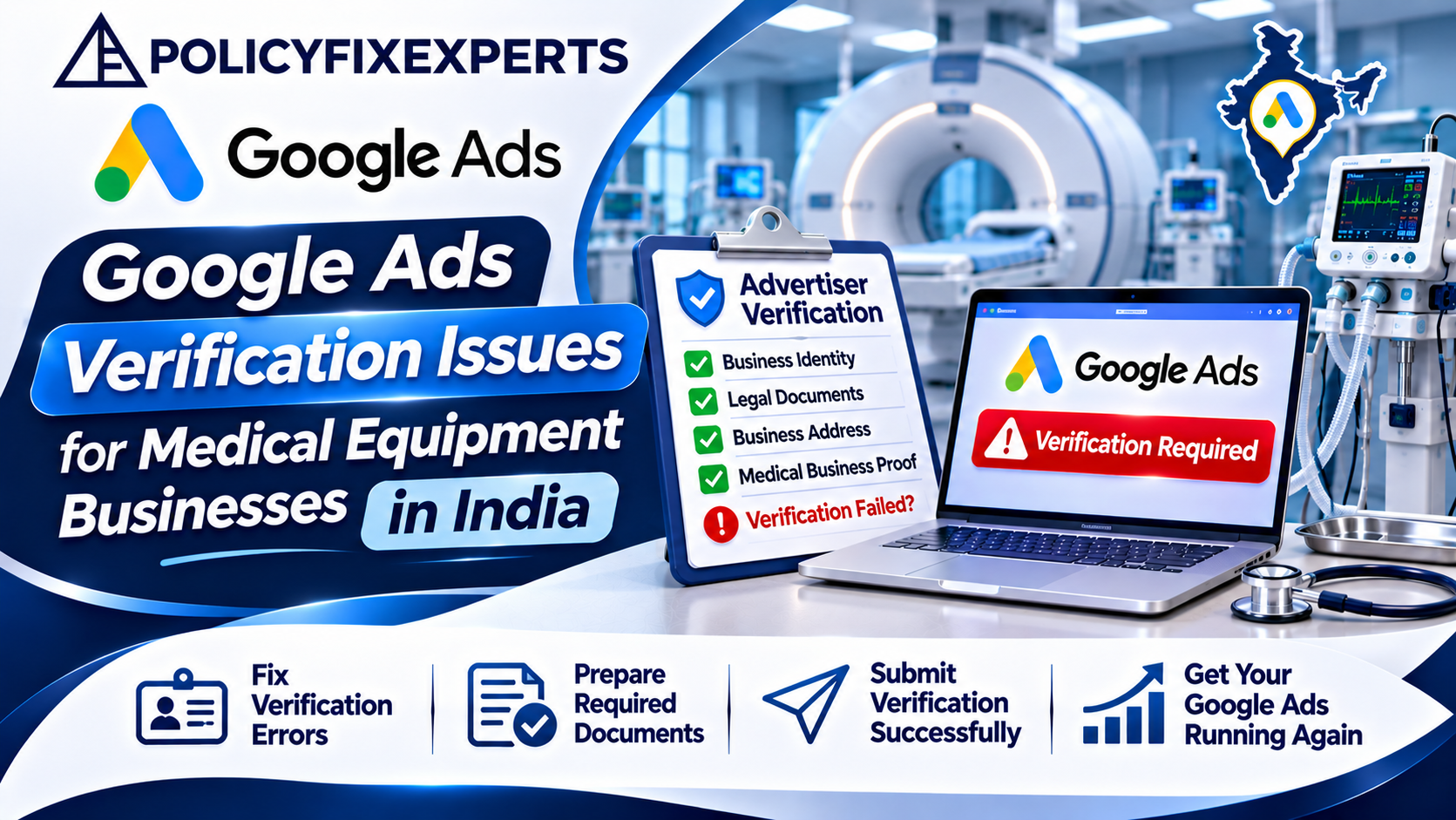
Running Google Ads helps medical equipment businesses reach hospitals, clinics, diagnostic centres, healthcare professionals, and distributors. However, before advertisements reach potential customers, Google may require businesses to complete advertiser identity verification, business operations verification, or additional industry-specific checks.
For medical equipment sellers in India, this process can get confusing. An advertiser might submit company registration documents, GST details, website information, and other business records, only to receive another verification request or an advertising restriction.
The issue isn't always related to the documents themselves. Differences between business information, unclear product descriptions, missing website details, and advertising policy restrictions can also create problems.
This guide explains why Google Ads Verification Support matters, which documents Indian advertisers may need, how to identify verification problems, and what steps help resolve them.
1. Why Do Medical Equipment Businesses Face Google Ads Verification Issues?
Google uses advertiser verification and industry-specific policy checks to establish who is advertising and whether the business meets applicable advertising requirements.
Medical equipment businesses encounter additional scrutiny because their products involve healthcare, patient safety, diagnostic procedures, and regulated medical claims.
Some common reasons include:
Inconsistent Business Information
Google compares information submitted during verification with details displayed on the advertiser's website and business documents.
For example:
The Google Ads account displays a different company name from the GST certificate.
The registered business address doesn't match the submitted documents.
The website displays a brand name without explaining the legal business behind it.
Contact details are incomplete or inconsistent.
Even small differences create confusion during verification.
Missing Business Documentation
Some advertisers submit incomplete or unclear documents.
Depending on the verification request, Google may require information such as:
Certificate of Incorporation.
GST registration certificate.
Business registration documents.
Proof of business address.
Identity documents for an authorised representative.
Other documents specifically requested by Google.
The exact requirements depend on the verification programme and the advertiser's circumstances.
Medical Advertising Policy Restrictions
Not every medical equipment product can be advertised under the same conditions.
Certain healthcare-related products, medical claims, and regulated devices face additional restrictions.
For example, advertising diagnostic equipment with unsupported claims about detecting diseases or guaranteeing medical outcomes raises policy concerns.
Advertisers should distinguish between identity verification problems and actual advertising policy violations. If you run into broader policy hurdles, you can consult Google's Official Advertiser Verification Documentation and review Google Ads Policy Violation Assistance.
2. Essential Documents for Google Ads Verification in India
Preparing accurate business documents before starting verification reduces avoidable submission problems.
Indian medical equipment businesses should organise their documentation according to the verification instructions displayed inside their Google Ads account.
| Document | Purpose |
|---|---|
| GST Registration Certificate | Helps establish business registration details |
| Certificate of Incorporation | Confirms company registration where applicable |
| PAN Details | Supports business identity verification when requested |
| Business Address Proof | Helps confirm the registered business address |
| Authorised Representative ID | Establishes the identity of the person completing verification |
| Official Website | Provides information about the business and its activities |
| Product Information | Clarifies the medical equipment being advertised |
Keep Business Details Consistent
Before uploading documents, check the following:
The legal business name matches the submitted registration documents.
The address is accurate and properly formatted.
The authorised representative has the necessary permission to complete verification.
Documents are valid, readable, and unaltered.
Website information accurately describes the business.
Practical example: Suppose an Indian company sells ultrasound scanners and patient monitoring equipment. Its Google Ads account uses a shortened brand name, while its GST certificate displays the full registered company name.
The website should clearly explain the relationship between the brand and the registered business. This helps reviewers understand the advertiser's identity.
3. Common Google Ads Verification Problems for Medical Equipment Sellers
Identifying the exact verification issue is more useful than repeatedly submitting the same documents.
Here are common problems businesses encounter.
Advertiser Identity Verification Failure
This happens when Google can't establish the advertiser's identity using the submitted information.
Possible reasons:
Incorrect legal business details.
Unclear or expired documents.
Mismatched registration information.
Incomplete representative details.
Recommended action: Review the verification instructions, correct inconsistencies, and submit the requested documentation again.
Business Operations Verification Issues
Google asks questions about how the business operates, including its relationship with manufacturers, distributors, suppliers, and customers.
For example, a medical equipment company may sell products manufactured by another organisation.
Its website and verification responses should clearly explain whether it's a manufacturer, authorised distributor, reseller, or service provider.
Recommended action: Provide accurate information about the business model, product sourcing, customer relationships, and relevant authorisations where requested.
Website Transparency Problems
A medical equipment website should clearly communicate who operates the business and what products or services it provides.
Common website issues include:
Missing contact information.
No clear company identity.
Incomplete product descriptions.
Unclear return or refund policies where applicable.
Missing terms and privacy information.
Unsupported medical product claims.
Recommended action: Review the website and make sure its business information is accurate, accessible, and consistent with the submitted verification details.
Healthcare Advertising Restrictions
Some medical devices and healthcare products require additional approvals, certifications, or eligibility checks depending on the product and target market.
Verification alone doesn't automatically make every medical product eligible for Google Ads.
Advertisers must review the applicable Google healthcare and medicines policies before launching campaigns.
4. How to Resolve Google Ads Verification Issues for Medical Equipment Businesses
If your medical equipment business faces verification difficulties, follow a structured approach instead of making repeated submissions.
Step 1: Identify the Exact Verification Requirement
Sign in to your Google Ads account and review the notifications or verification section.
Identify whether the issue concerns:
Advertiser identity.
Business operations.
Payment profile.
Healthcare advertising eligibility.
A separate advertising policy violation.
Each issue requires a different response.
Step 2: Review Your Business Information
Compare the details in your Google Ads account with your official business documents.
Check:
Registered company name.
Business address.
Contact information.
Website domain.
Authorised representative details.
Correct genuine inconsistencies before submitting anything again.
Step 3: Audit Your Website
Review the pages customers and Google's reviewers use to understand your business.
Important pages include:
About Us.
Contact Us.
Medical Equipment Products.
Privacy Policy.
Terms and Conditions.
Shipping and Return Policy, where applicable.
Make sure product descriptions accurately explain the equipment's purpose and specifications.
Avoid exaggerated claims like guaranteed diagnosis, 100% accuracy, or guaranteed medical outcomes unless properly substantiated and permitted under applicable policies.
Step 4: Check Product Eligibility
Review Google's healthcare and medicines advertising requirements for the products you intend to promote.
For example, diagnostic machinery, medical imaging equipment, monitoring devices, and other medical products have different advertising considerations.
Also check applicable Indian requirements, including relevant Central Drugs Standard Control Organisation (CDSCO) Regulations where they apply to the specific product.
Don't assume that GST registration or a business licence automatically establishes advertising eligibility.
Step 5: Submit Accurate Verification Information
Once necessary corrections are complete:
Open the relevant verification process.
Follow Google's current document requirements.
Upload clear and valid documents.
Provide accurate answers about business operations.
Submit the information for review.
Monitor the account for further requests.
Avoid submitting unrelated documents or providing information that official records can't support.
Step 6: Request a Review When Appropriate
If verification fails despite providing accurate information, review the stated reason and use the available Google support or appeal process.
Explain the issue clearly and provide relevant supporting evidence.
Repeated appeals without addressing the original problem rarely help.
5. Medical Equipment Advertising Compliance: What Indian Businesses Should Know
Google Ads verification and healthcare advertising compliance are related but separate requirements.
A business can successfully verify its identity and still face restrictions on specific medical products or advertising claims.
Indian advertisers should pay attention to the following areas.
Medical Device Regulatory Requirements
Medical devices in India are regulated under the Medical Devices Rules, 2017, and other applicable provisions.
Depending on the product category, manufacturers, importers, and distributors have specific registration, licensing, or compliance obligations.
Businesses should confirm that the products they advertise meet applicable regulatory requirements.
Accurate Product Claims
Medical equipment advertisements should focus on factual product information.
Appropriate information includes:
Equipment specifications.
Intended purpose.
Technical features.
Manufacturer information.
Warranty details.
Available support services.
Avoid unsupported claims about curing diseases, guaranteeing treatment outcomes, or replacing professional medical advice.
Clear Business Relationships
If your company is an authorised distributor or reseller, explain that relationship accurately.
Don't claim to be the manufacturer or an officially approved partner unless you have the relevant authorisation.
Important: Compliance with Indian medical device regulations doesn't automatically guarantee Google Ads approval. Both regulatory requirements and Google's advertising policies need consideration.
6. When Should Medical Equipment Businesses Seek Google Ads Verification Support?
Some verification problems resolve internally by correcting business details and submitting the right documents.
However, professional assistance helps when the issue involves repeated verification failures, complicated business structures, or unclear healthcare advertising restrictions.
Consider seeking specialist support when:
Your advertiser verification repeatedly fails.
Google requests additional business operation information.
Your medical equipment advertisements receive policy restrictions.
Your website information conflicts with submitted documents.
You are unsure whether your products qualify for advertising.
Your account has multiple unresolved verification requirements.
A professional review focuses on identifying the actual issue rather than promising guaranteed approval. If you manage multiple ad channels, you might also need Facebook Business Account Recovery or Google Merchant Center Suspension Recovery. For a complete overview of strategies, check out our general Google Ads Account Suspension Recovery guides. To scale up your traffic cleanly, pair these fixes with professional Digital Marketing Services.
What Should a Reliable Support Provider Review?
Before choosing an account recovery or advertising compliance service, check whether the provider can:
Identify the exact verification or policy issue.
Review business documents and website information.
Explain relevant Google Ads requirements.
Identify product-specific advertising restrictions.
Recommend corrective actions.
Help organise accurate appeal or verification information.
The business should retain ownership and control of its Google Ads account. Never share passwords or sensitive account credentials unnecessarily.
Frequently Asked Questions
1. Why does Google Ads require verification for medical equipment businesses?
Google requires advertiser identity verification, business operations verification, or additional industry-specific checks to establish who is advertising and whether the business meets applicable advertising requirements.
2. Which documents are required for Google Ads verification in India?
Depending on the verification programme, Google requests GST registration, company incorporation documents, business address proof, authorised representative identification, or other supporting records.
3. Can medical equipment businesses advertise on Google Ads?
Yes, eligible medical equipment businesses can advertise products complying with Google's advertising policies and applicable local regulations. Certain healthcare products and claims have additional restrictions.
4. Does successful advertiser verification guarantee medical equipment ad approval?
No. Advertiser verification confirms information about the advertiser, but individual advertisements and products must separately comply with Google's advertising policies.
5. What should I do if my medical equipment Google Ads verification keeps failing?
Review the exact rejection reason, check business document consistency, correct website transparency issues, and submit accurate information through the available verification or support process.
Conclusion
Google Ads verification issues for medical equipment businesses arise from inconsistent company information, incomplete documentation, unclear business operations, website transparency problems, or additional healthcare advertising restrictions.
For Indian advertisers, the best approach is to identify the exact verification requirement, prepare accurate business records, review website information, and confirm that advertised products meet applicable advertising and regulatory requirements.
If your medical equipment business continues to experience verification difficulties, PolicyFix Experts helps review Google Ads verification concerns, identify potential compliance gaps, and guide you through the appropriate next steps.
Need help understanding your Google Ads verification issue? Visit PolicyFix Experts and explore available account verification and Google Ads Compliance Support.